Can You Copyright AI Art? The Complete 2026 Guide
Navigating the complex landscape of AI art copyright in 2026. Learn about human authorship thresholds, recent legal battles, and how to protect your generative AI creations.
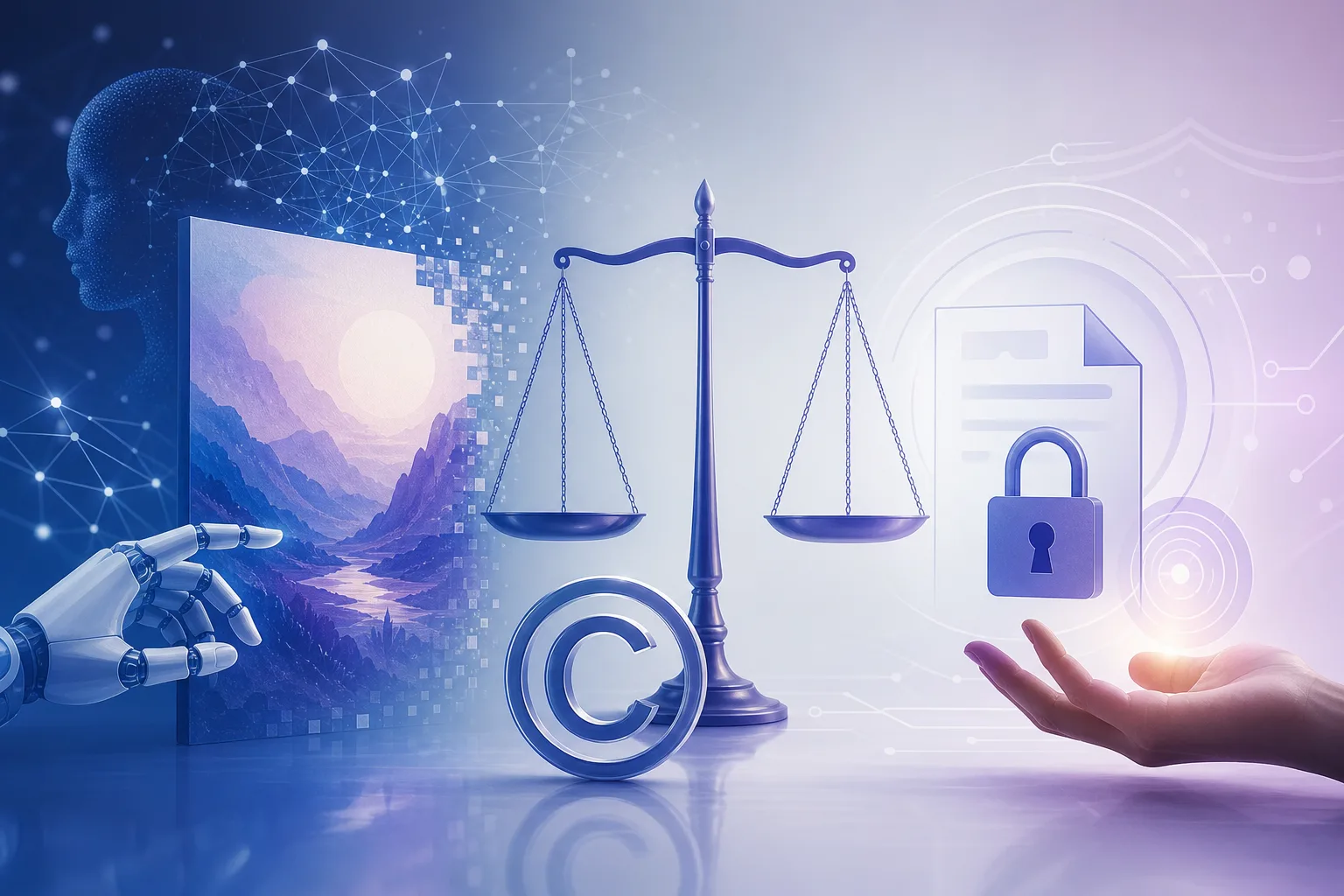
Can You Copyright AI Art? The Complete 2026 Guide
The intersection of artificial intelligence and creative expression has fundamentally shifted. For creators, businesses, and developers navigating this landscape, the most pressing question remains: is AI art copyrighted?
As we settle into 2026, the landscape of AI art copyright has evolved significantly from the early wild west of generative AI. Courts, legislatures, and copyright offices worldwide have established clearer boundaries regarding what can and cannot be protected when algorithms assist in the creative process.
This guide provides a comprehensive overview of AI generated art copyright in 2026, examining the current legal frameworks, recent court rulings, and practical steps you can take to protect your creative works.
The State of AI Art Copyright in 2026
The fundamental principle governing copyright law—that copyright only protects works created by human beings—remains intact in 2026. The U.S. Copyright Office (USCO) and courts in most jurisdictions consistently hold that a purely non-human creation cannot claim copyright protection.
However, the reality of modern content creation is nuanced. The debate has shifted from "can an AI own a copyright?" (the answer is still unequivocally no) to "how much human input is required for an AI-assisted work to be copyrightable?"
The Human Authorship Requirement
To obtain an ai generated art copyright, you must demonstrate substantial human authorship. This means the human creator must have creative control over the final expression, not merely the underlying idea.
Typing a simple prompt like "a cyberpunk city at night" into Midjourney or DALL-E is generally considered analogous to giving instructions to a commissioned artist. The resulting image is the AI's expression of that idea, not yours. Therefore, that specific image lacks human authorship and is not eligible for copyright.
When AI-Assisted Art Becomes Copyrightable
While purely generated images lack protection, AI art copyright 2026 guidelines recognize that AI can be used as a tool within a broader human-driven creative process. You may be able to copyright a work that incorporates AI art if:
1. Substantial Modification: You heavily edit, manipulate, or paint over the AI-generated base image using traditional digital art tools (like Photoshop). The copyright protects your human modifications, not the original AI output.
2. Complex Arrangement: You arrange multiple AI-generated elements in a highly creative and original composition. The copyright protects the specific arrangement and curation, but potentially not the individual elements.
3. Iterative Control: You use tools like ControlNet or detailed img2img workflows where you are directing the structural composition, pose, and specific details, reducing the AI's role to rendering rather than conceptualizing.
It is crucial to understand that in these scenarios, the copyright protection extends only to the human-authored elements.
Key Developments in AI Copyright Law (2024-2026)
To understand why ai art copyright 2026 operates the way it does, we must look at the pivotal legal precedents established in recent years.
The "Prompting is Not Authorship" Precedents
Several high-profile cases solidified the stance that crafting prompts, no matter how complex or iterative, does not constitute authorship. Courts reasoned that prompts dictate what to create (the idea) but leave the how (the expression) to the AI model's latent space.
The Rise of "Thin Copyrights"
A significant trend in 2026 is the issuance of "thin copyrights" for AI-assisted works. When registering a work with the USCO, applicants are now strictly required to disclose the use of AI.
If the Office determines the work contains both human and AI-generated elements, they will issue a registration that explicitly excludes the AI-generated portions. This "thin copyright" only protects the specific human contributions. For example, in a comic book using AI art, the text, layout, and storyline might be protected, while the individual AI-generated panels are not.
Training Data and Fair Use Battles
While this guide focuses on protecting generated output, the legal battles surrounding the input—the copyrighted works used to train AI models—continue to shape the industry. Major lawsuits involving authors, artists, and code repositories have established complex precedents regarding whether training an AI model constitutes copyright infringement or falls under fair use.
These rulings have led to the development of robust opt-out mechanisms, such as AI-specific robots.txt implementations, allowing creators to prevent their work from being scraped for training data. (You can test your site's vulnerability using our robots.txt AI blocker tool).
How to Protect Your AI-Assisted Works
If you are incorporating AI into your creative pipeline, navigating ai art copyright requires strategic planning.
Document Your Creative Process
The burden of proof lies with the creator to demonstrate human authorship. Keep meticulous records of your workflow:
* Save early sketches or concept art.
* Record screen captures of your editing process.
* Retain the original prompts and initial AI outputs to show the transformation.
* Use version control for complex projects.
Disclose AI Usage Properly
Attempting to hide the use of AI when registering a copyright is a dangerous strategy. The USCO requires clear disclosure. Failing to do so can result in the cancellation of your registration or render it unenforceable in court.
Use our AI Disclosure Generator to ensure your applications meet current 2026 standards.
Focus on Value-Added Human Effort
Don't rely on raw AI output. Use AI as a starting point, a brainstorming tool, or a way to generate textures and background elements. Invest human effort in refining, compositing, writing, and structuring the final product. The more of you that is in the work, the stronger your copyright claim.
Google's Stance on AI Content
A common concern among web creators is whether publishing AI-assisted content (including images and text) will incur SEO penalties. Google's core philosophy, established in 2023 and maintained through 2026, focuses on rewarding high-quality content, regardless of how it is produced.
Using AI to generate spam or manipulate search rankings is a strict violation of Google's spam policies. However, using AI to create helpful, original, people-first content that demonstrates E-E-A-T (Expertise, Experience, Authoritativeness, and Trustworthiness) is permissible.
When discussing complex legal topics like is ai art copyrighted, the focus must be on providing accurate analysis, citing reliable sources, and offering genuine value to the reader.
Conclusion
The landscape of ai art copyright 2026 is not about banning AI, but about clearly defining the boundaries of human authorship. While you cannot copyright a raw image generated by an AI prompt, you can protect works where AI is used as a tool within a substantially human creative process.
As generative technology continues to advance, the legal frameworks will undoubtedly face new challenges. Creators must stay informed, document their processes meticulously, and always prioritize human ingenuity and creative control.
*
Disclaimer: This article provides educational information about AI copyright law and trends as of 2026. It does not constitute legal advice. Copyright law is complex and subject to jurisdictional differences. Consult with a qualified intellectual property attorney regarding your specific situation.
Related Articles
AI Copyright Infringement Penalties in 2026: Fines, Damages & Consequences
What fines and damages can AI companies actually face for copyright infringement in 2026? A deep div...
GuideWho Owns AI-Generated Code? Copyright, GitHub Copilot & the 2026 Legal Landscape
Can you copyright AI-generated code? What the GitHub Copilot lawsuit, US Copyright Office, and globa...
GuideHow to Find an AI Copyright Attorney for Your Case (2026)
Whether you've received a cease-and-desist letter, discovered your work in an AI training dataset, o...
GuideIs AI Training Fair Use? How Global Copyright Laws Are Evolving in 2026
Is training AI on copyrighted data fair use? The answer depends on where you are. Here's how the US,...
GuideDrafting a Corporate Policy for AI-Generated Content (2026 Template)
Learn how to draft a comprehensive corporate policy for AI-generated content in 2026. Includes a rea...