9 Class Actions Hit Big Tech Over AI Voiceprints: How BIPA Just Opened a New Front
A coalition of Chicago journalists, podcasters, and audiobook narrators filed nine BIPA class actions in May 2026 against Google, Amazon, Apple, Microsoft, Meta, NVIDIA, Adobe, Samsung, and ElevenLabs over AI voiceprint training. Here's why this case routes around fair use and could reshape voice AI.
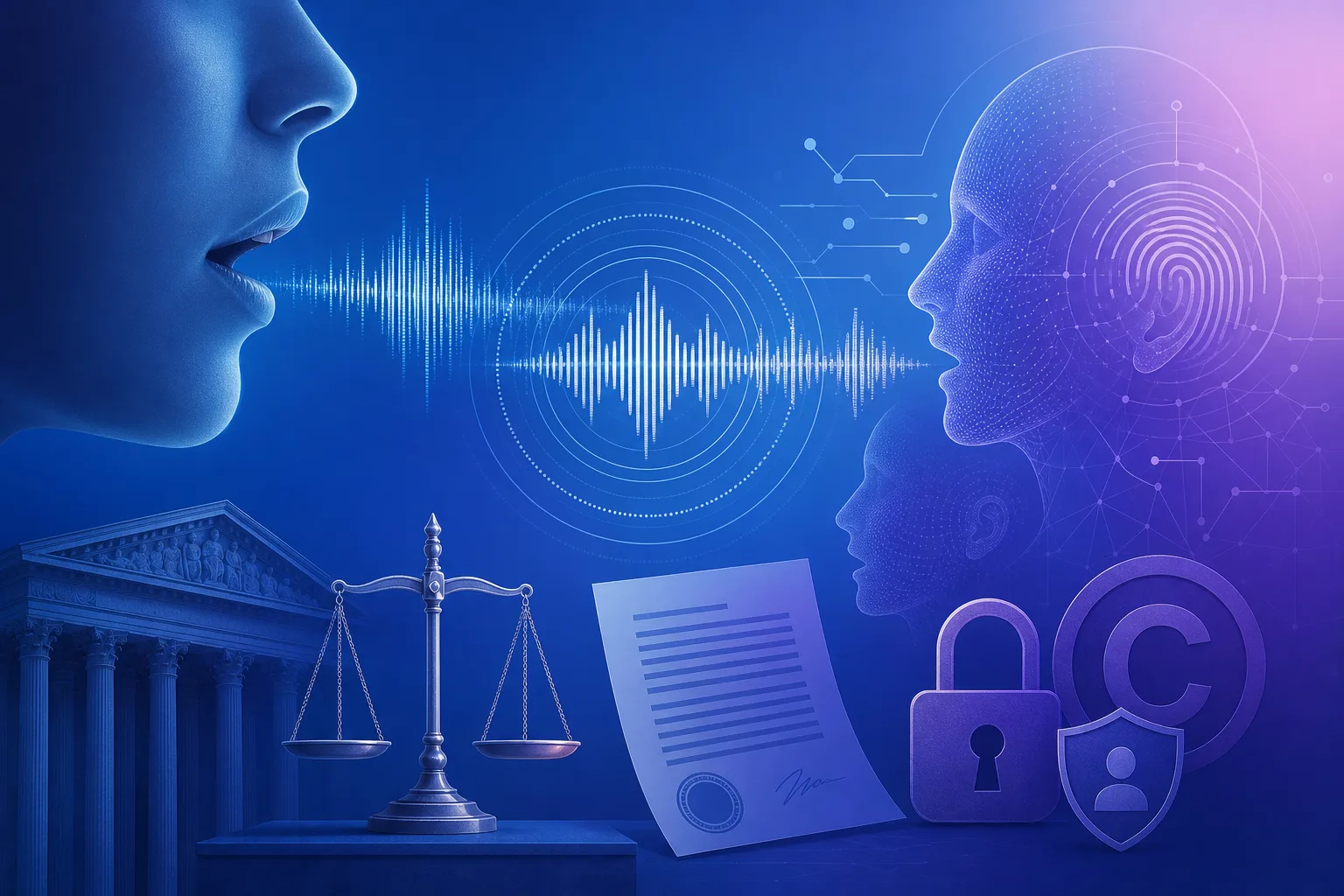
9 Class Actions Hit Big Tech Over AI Voiceprints: How Illinois' BIPA Just Opened a New Front in the AI Copyright War
A coalition of award-winning Chicago journalists, podcasters, and audiobook narrators has filed nine class-action lawsuits in federal court accusing the world's largest technology companies of "stealing" their voices to train commercial AI voice models. The defendants read like a roll call of the AI industry: Google, Alphabet, Amazon, Apple, Microsoft, Meta, NVIDIA, Adobe, Samsung, and ElevenLabs.
The cases, filed in the Northern District of Illinois between May 11 and May 13, 2026, are not framed as copyright suits in the traditional sense. Instead, they invoke Illinois' Biometric Information Privacy Act (BIPA) — the strongest-in-nation biometric data law — and argue that the companies extracted "voiceprints" from publicly available recordings without the written consent BIPA requires.
If the courts agree, the implications go well beyond a few audiobook narrators in Chicago. The complaints argue something legally novel and potentially explosive: that the trained model itself contains the biometric data, and that the model and the data are now "the same thing."
Disclaimer: This article is for informational purposes only and is not legal advice. If you believe your voice or other biometric identifiers may have been used in AI training, consult a qualified attorney.
What Happened: Nine Lawsuits, One Coordinated Theory
Filed by Chicago plaintiffs' firm Loevy & Loevy, the cases share a common factual backbone: each plaintiff is an Illinois-based voice professional whose recorded work — broadcast segments, podcast episodes, audiobook narrations — is widely available online. The complaints allege that defendants scraped that audio, extracted "biometric voiceprints," and used those voiceprints to train commercial voice AI products.
The named plaintiffs include:
- Carol Marin and Philip Rogers, retired NBC 5 Chicago broadcast journalists
- Yohance Lacour, Alison Flowers, and Robin Amer, investigative podcasters
- Lindsay Dorcus and Victoria Nassif, professional audiobook narrators
Each defendant is sued in a separate complaint, but the legal theory is uniform. The Google complaint, for example, identifies specific products allegedly built on voiceprint training: Gemini Live, NotebookLM Audio Overviews, YouTube auto-dubbing, Google Cloud Text-to-Speech, and Google Assistant.
According to a statement from Loevy & Loevy attorney Ross Kimbarovsky, "What we are seeing is an illegal and unethical exploitation of talent on a massive scale, and one of the largest violations of biometric privacy ever committed."
None of the named defendants had publicly responded to the lawsuits at the time of filing.
Why BIPA Matters: The Sharpest Tool in the U.S. Privacy Toolbox
BIPA, passed in 2008, is the most plaintiff-friendly biometric privacy statute in the United States. It requires companies that collect biometric identifiers — fingerprints, face scans, retinal scans, or voiceprints — to:
1. Provide written notice that biometric data is being collected
2. Specify the purpose and length of collection
3. Obtain written consent before collection
4. Publish a publicly available retention and destruction policy
Crucially, BIPA includes a private right of action. Plaintiffs can recover statutory damages of $1,000 per negligent violation and $5,000 per intentional or reckless violation, without proving any actual harm. In a class action covering thousands of recordings, that arithmetic gets large quickly.
That math is exactly why BIPA reshaped the privacy landscape over the past decade:
- Facebook paid $650 million in 2020 to settle a face-recognition class action.
- Google has previously settled multiple BIPA suits over biometric data collection.
- Whole Foods, an Amazon subsidiary, settled a 2023 voiceprint case brought by warehouse workers — the first known BIPA voiceprint settlement.
What makes the May 2026 filings different is scale and target. Earlier BIPA voiceprint cases involved hundreds of warehouse employees and a single use case (clock-in verification). The new cases target the entire generative AI voice industry and reach a much larger class of potential plaintiffs: anyone whose recorded voice was scraped from the web in Illinois.
The Legal Theory: "The Biometric Data and the Product Are the Same Thing"
The most consequential line in the Google complaint is also its most ambitious legal argument:
"The voiceprints Google extracted from Plaintiffs are not stored in a database that can be deleted on request. They are encoded in the parameters of Google's commercial voice models and reproduced in the audio that those models generate. At this point, the biometric data and the product are the same thing."
Read carefully, that sentence does three things:
1. It treats model weights as a form of biometric storage, not just statistical inference.
2. It pre-empts a likely defense that voiceprints were "transient" or never retained.
3. It frames the only effective remedy as model destruction or retraining — not just deleting a database row.
If a court accepts this framing, it could become a template for biometric and copyright plaintiffs across the AI industry. Compare it to the recent NVIDIA shadow library ruling, where the court found that AI training scripts had "no other purpose" than copyright infringement. Both cases share a theme: courts are increasingly willing to look past the abstraction of "training" and examine what data actually went in and what came out.
Voice as Biometric, Not Just Performance
The complaints draw a careful distinction between performance (which copyright handles) and biometric identity (which BIPA handles). A voiceprint, the lawsuits explain, is "a mathematical representation" of someone's voice — including pitch, timbre, and resonance determined by physiology, plus speech patterns developed over a lifetime.
The legal punchline is that voiceprints, like fingerprints, are immutable:
"A Social Security number can be reissued. A person whose voiceprint has been taken cannot recover it by altering their voice — the biological and behavioral patterns that produced the voiceprint are the same ones used to speak every day."
This framing matters because it sidesteps the fair-use defense that has dominated AI training litigation. Fair use is a copyright doctrine. BIPA is a state privacy statute, and it does not have a fair-use carve-out. A defendant who might win under fair use analysis could still lose under BIPA's strict consent regime.
What Each Defendant Is Accused Of
While the complaints share a common theory, the products and use cases vary across defendants:
| Defendant | Allegedly Built On Voiceprints | Notable Products |
|-----------|-------------------------------|------------------|
| Google / Alphabet | Foundational voice models | Gemini Live, NotebookLM Audio, YouTube auto-dub, Cloud TTS, Assistant |
| Amazon | Commercial voice AI | Alexa voice, Polly, audiobook narration tools |
| Microsoft | Voice generation models | Azure AI Speech, Copilot voice |
| Meta | Voice and audio models | Messenger AI voice, Voicebox-class systems |
| Apple | Speech and voice systems | Siri, voice cloning features |
| NVIDIA | Foundation voice models | NeMo speech models, Riva |
| Adobe | Voice synthesis | Project VoCo-class tooling, generative audio |
| Samsung | Voice systems | Bixby and on-device voice models |
| ElevenLabs | Voice cloning | Commercial voice cloning platform |
(Note: This table reflects the categories of products described in the complaints and public reporting. Specific allegations against each defendant are detailed in their respective complaints.)
A particularly sharp grievance, repeated across complaints: the AI voice products built on these voiceprints are now competing directly with the plaintiffs' own professions. Audiobook publishers can use Google or Amazon TTS to replace human narrators. NotebookLM Audio Overviews can synthesize podcast-style content that competes with investigative audio journalism.
How This Connects to the Broader AI Copyright Fight
The voiceprint cases sit at an intersection that has gotten increasingly crowded in 2026. The same week these suits were filed, federal judges were also weighing:
- The delayed approval of Anthropic's $1.5B author settlement, which centered on book training data
- The Cruz v. Anthropic class action brought by 28 authors
- The Strike 3 v. Meta lawsuit over alleged use of pirated video
What's distinctive about the BIPA voiceprint cases is the legal vehicle. Until now, the AI copyright fight has played out almost entirely under federal copyright law, with fair use as the central battleground. The voiceprint suits route around that battle entirely:
- They invoke a state biometric privacy law, not federal copyright.
- They define the protected interest as bodily identity, not creative authorship.
- They demand destruction of biometric data — which the complaints argue means the model itself.
For tech companies, this is a strategic problem. Even if the industry eventually wins clarity on fair use under federal law, BIPA-style claims would remain a separate liability surface. Other states — Texas, Washington, and a handful of newer entrants — already have biometric statutes, though none with BIPA's combination of private right of action and per-violation damages.
Voice Cloning and the Sora 2 Moment
The timing of these suits is not coincidental. The past 18 months have seen voice cloning move from research demo to mainstream product, and litigation has begun to follow. Just three months before these filings, former NPR Morning Edition host David Greene sued Google in California, alleging that his voice had been used to train an AI product without authorization.
We covered the broader voice-cloning legal landscape in our analysis of Sora 2 and voice cloning copyright issues. The BIPA cases extend that fight in a new direction: instead of arguing that an AI-generated voice infringes a specific recording, plaintiffs argue that the act of training itself was unlawful biometric collection.
That is a stronger position for plaintiffs in many ways. Output-based claims require proving that a generated voice is substantially similar to a specific copyrighted performance. Voiceprint claims focus on the input side, where the question is simpler: did the company collect biometric data without consent?
Possible Outcomes
It's early. Filings of this scale typically take 12 to 24 months to reach a meaningful ruling, and defendants will almost certainly file motions to dismiss on multiple grounds:
- Standing under Spokeo / TransUnion: Whether mere voiceprint extraction creates Article III injury
- Extraterritoriality: Whether BIPA reaches conduct that occurs outside Illinois
- First Amendment: Whether training on publicly available speech is protected
- Preemption: Whether federal copyright law preempts state biometric claims as applied to publicly available recordings
That said, prior BIPA appellate history has been notably plaintiff-friendly. The Illinois Supreme Court's 2023 Cothron v. White Castle decision affirmed that each scan can be a separate violation, supercharging potential damages. Defendants who lose motions to dismiss often settle rather than risk trial.
Likely outcomes range from:
1. Early dismissal on standing or extraterritoriality — least likely, given prior BIPA rulings
2. Significant settlements — historically the most common BIPA endgame
3. Mixed rulings that allow some claims (e.g., Illinois-recorded content) but bar others
4. A precedent-setting ruling on whether model parameters constitute biometric storage — the highest-stakes path
Any of those outcomes will reshape how AI voice models are trained, documented, and deployed.
What Voice Professionals Should Do Now
If you are a journalist, podcaster, voice actor, or audiobook narrator with substantial publicly available audio, this is a moment to pay attention.
- Document your work: Maintain records of where and when your voice recordings were published. Class membership in BIPA cases often turns on Illinois nexus.
- Review terms of service: Some platforms now claim broad rights to use uploaded audio for AI training. Read before you upload.
- Consider opt-out signals: Tools like robots.txt directives for AI crawlers and AI-disclosure tags can establish a clearer record of non-consent.
- Watch the class-action notice channels: If certified, these classes will likely use standard BIPA notice procedures. Anyone with relevant Illinois recordings could be eligible.
- Talk to a lawyer for individual claims: Some voice professionals may have stronger individual claims than class claims, particularly if their voices appear in distinguishable AI outputs.
What Businesses Building Voice AI Should Do
For companies building or deploying voice AI, the message from Chicago is unambiguous: the consent question is no longer optional. A few practical steps that go beyond standard copyright due diligence:
- Audit training data for biometric content sourced from Illinois (or any state with a biometric statute).
- Implement consent workflows for voice contributors, modeled on BIPA's written-notice and written-consent requirements.
- Adopt a biometric retention policy and publish it. BIPA requires this regardless of whether you face suit today.
- Document data provenance for voice training corpora at a level of specificity that lets you respond to discovery requests.
- Reconsider scraping policies for podcast feeds, YouTube audio, and audiobook samples in particular.
We've published a more general framework for compliance in our AI Copyright Compliance: 2026 Survival Guide for Businesses, but voice-AI builders should treat BIPA as a separate, parallel obligation.
Key Takeaways
- Nine BIPA class actions filed in Chicago federal court between May 11 and 13, 2026, target Google, Amazon, Apple, Microsoft, Meta, NVIDIA, Adobe, Samsung, and ElevenLabs.
- The cases use Illinois biometric privacy law, not federal copyright, to argue that voiceprints extracted for AI training were collected without required consent.
- A central legal theory: the model parameters and the biometric data are "the same thing," meaning destruction of unlawfully collected data may require model retraining.
- BIPA's per-violation statutory damages ($1,000-$5,000) and prior settlements (Facebook $650M, Google multiple cases) make these suits financially serious.
- The cases route around the fair-use defense that has dominated AI copyright litigation, opening a new front for plaintiffs across the industry.
- Voice professionals with Illinois-recorded work should monitor class certification; voice-AI builders should treat biometric consent as a distinct obligation from copyright clearance.
Voice has always been a strange edge case in copyright — a performance, an instrument, an identity, all at once. The Chicago plaintiffs are betting that identity is the right legal lens for what generative voice AI actually does. The next two years of rulings will tell us whether courts agree.
This article is part of our ongoing coverage of AI copyright and biometric privacy litigation. For a comprehensive list of active cases, see our AI Copyright Lawsuit Tracker. For an overview of how AI training intersects with copyright law, see Is AI Training Fair Use?. This article is for informational purposes only and does not constitute legal advice.
Related Articles
CNN Sues Perplexity AI: Copyright and Trademark Claims Target AI 'Answer Engine'
CNN filed a 54-page complaint against Perplexity AI on May 28, 2026, alleging copyright and trademar...
NewsThe AI Arbitrator Is Now Deciding Real Cases — What It Means for Copyright, Justice, and You
The AAA has deployed the first AI-powered arbitrator handling live disputes. One case is already on ...
NewsAI Fabricated Quotes in a Book About Truth — The Irony, the Fallout, and What It Means for Creators
When AI tools fabricated quotes in a book about AI and truth, it exposed a systemic failure in publi...
NewsTech Industry Backs Anthropic in Music Publishers Lyrics Case, Citing Fair Use
Tech industry organizations filed amicus briefs this week supporting Anthropic's fair use defense ag...
NewsYouTube Opens AI Likeness Detection to Everyone: What Creators Need to Know
YouTube's AI likeness detection tool is now live for all eligible creators 18 and over. Here's how i...